
The third largest major joint, which is also widely used for endoprosthetics, is the shoulder joint.
The shoulder joint is the most mobile joint, and it can move around three mutually perpendicular axes: transverse, sagittal, and vertical.


in the area of the sagittal axis, shoulder abduction and adduction occur, around
transverse — forward movement (flexion) and backward movement (extension), around vertical — turning inwards and outwards, i.e. pronation and supination. In addition, circular motion (circumduction) is possible in the shoulder joint. Thus, restoring the function of this joint is extremely important. One of the ways to treat injuries and diseases of the shoulder joint is endoprosthetics. It can also be total or unipolar.
Indications for shoulder joint replacement:
- Osteonecrosis of the head of the humerus (Hass disease) – a condition in which part of the cells of the head of the humerus dies and gradually resolves.
- Fractures of the proximal humerus – type VI according to Neer (anterior and posterior fractures-dislocations of the humerus), including splitting of the head and impression fractures, especially in elderly patients, since the reparative capabilities and bone quality decrease with age. In old age, multi-comminuted fractures often do not heal even with perfect matching of fragments and fixation, since the blood supply to the head is disrupted with age. Moreover, for complex fractures in elderly patients, open reposition and osteosynthesis can lead to long-term rehabilitation, non-fusion, and adhesive capsulitis.
- Post-traumatic osteoarthritis of the shoulder joint. As a rule, these are incorrectly fused fractures of the humerus, when it is no longer possible to ‘break the bone again and put everything in place.’
- Comminuted fractures of the scapular joint cavity that contribute to dislocation of the humerus head, including incorrectly fused fractures that make the shoulder joint unstable;
- Degenerative-dystrophic diseases of the shoulder joint that developed after extensive damage to the rotator cuff of the shoulder (English-Cuff Tear Arthropathy-CTA, arthropathy of the torn rotator cuff).
- Progressive rheumatoid arthritis of the shoulder joint.
- Congenital dysplasia (abnormal development) of the shoulder joint, which affects the function of the shoulder joint.

The most common indication for endoprosthetics of the shoulder joint are multi-comminuted fractures of the humerus head. Such fractures with a conservative method of treatment end in aseptic necrosis, resorption of bone fragments, resulting in functional insufficiency of the shoulder joint and pain.
A clinical case
Patient F., 53 years old, was injured in an accident, the NSR was taken to the regional hospital, transferred to the hospital in GB 40. Upon admission, immobilization was performed, a comprehensive examination was performed: radiography (Fig. 1), CT examination (Fig. 2).

A diagnosis has been made:
- Multiple limb injuries.
- Closed comminuted fracture of the head, surgical neck of the left humerus with displacement of fragments.
- Closed acromion fracture of the left scapula with displacement of fragments. Closed fracture of the scapular body without displacement of fragments.
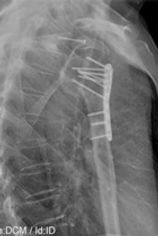
Given the young age, concomitant fracture of the scapula, and the patient’s desire to preserve the joint , it was decided to perform osteosynthesis with a plate and screws with angular stability.
3, 4) – open reposition, osteosynthesis of the left humerus with a plate with angular stability of screws and filling the bone defect with biodegradable cement. Fixing the acromion with a screw.
After the operation, a control X-ray examination was performed in two projections (Figs. 5, 6).
The postoperative period was uneventful. The patient was discharged for outpatient treatment in standard terms after surgery.
After discharge, he continued his outpatient treatment. Control X-ray images showed signs of aseptic necrosis of the humerus head 1 month after surgical treatment (Fig. 7).


To restore the function of the shoulder joint and reduce pain, the patient was offered surgical treatment – total endoprosthesis replacement of the shoulder joint. He was hospitalized as planned in the trauma department of the city hospital 40. He was prepared for surgery and underwent total endoprosthetics of the shoulder joint.
8, 9) revealed complete destruction of the head of the humerus, which is an indication for joint replacement. The operation was performed according to the standard procedure (Figs. 10, 11)
After the operation, X-ray control of the endoprosthesis position was performed (Fig. 12, 13).
On the 7th day after the operation, the patient was discharged for outpatient treatment, after the wound was healed, he was sent for rehabilitation treatment, during follow-up examinations, the function of the upper limb was gradually restored, and the pain syndrome was practically stopped.
Follow-up examination 4 months after the injury (2.5 months after shoulder replacement) (Fig. 14, 15, 16, 17).
The patient actively develops movements in the operated joint (independently swims in the pool). To fully restore the function of the upper limb, the patient is sent for rehabilitation treatment.